

From Fragmentation to Standardisation: KEYSTONE’s Roadmap for Europe’s Digital Transport Ecosystem

The European logistics and transport sector continues to face significant fragmentation across regulations, operational practices, and digital systems, limiting interoperability, reducing efficiency, and increasing compliance costs.
To address these challenges, TTS - Italia, a partner of the KEYSTONE project, has released the White Paper Evidence-Based Policy Recommendations and Roadmap for Large-Scale Deployment of Digital Transport Ecosystems, presenting a set of evidence-based recommendations to support the transition towards a standardised and scalable digital transport ecosystem.
At the heart of the initiative is a clear priority: enabling decision-makers to rely on harmonised, reliable, and actionable data. Project findings show that both public authorities and logistics operators still struggle with inconsistent standards, limited data accessibility, and difficulties in translating insights into operational decisions.
The White Paper identifies key barriers to large-scale digital deployment, including fragmented regulatory frameworks across Member States, low system interoperability, and growing complexity in meeting compliance requirements.
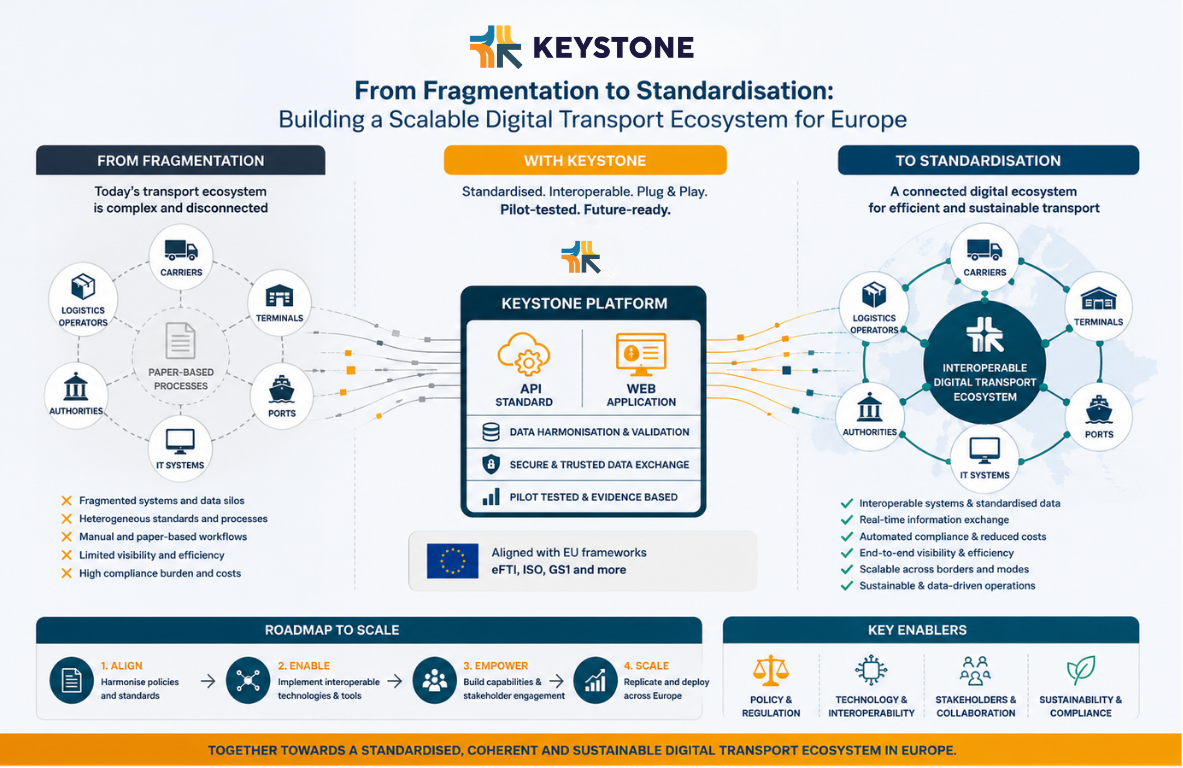
In response, KEYSTONE proposes a multi-layered policy and regulatory framework grounded in pilot results, benchmarking, and stakeholder engagement. Rather than offering abstract recommendations, the project delivers a practical roadmap linking policy objectives with real-world implementation.
This roadmap outlines a progressive pathway where policy alignment, technology development, and stakeholder collaboration evolve together. It emphasises the need for common data exchange rules, alignment with frameworks such as eFTI, and compatibility with international standards like ISO and GS1.
Beyond policy, the White Paper focuses on operational readiness—highlighting the need for practical implementation toolkits, digital auditing methods, and clear procedures for integrating data into existing logistics systems.
A strong emphasis is also placed on capacity building, with recommendations for training programmes, shared guidelines, and cross-sector collaboration mechanisms. This reflects a shift towards a more holistic, ecosystem-driven approach to digitalisation.
Among the key recommendations:
Greater regulatory harmonisation at the EU level
Interoperability by design through open APIs and standardised data models
Integration of compliance and sustainability requirements into digital systems
Strengthened public-private collaboration across the logistics value chain
Looking ahead, the proposed approach supports the development of pan-European digital logistics standards, “Logistics as a Service” models, and interoperable transport systems across multimodal corridors.
As the project enters its final phase, KEYSTONE is now focusing on assessing the replicability of its solutions. The aim is to ensure that the results can be effectively scaled and adapted across different contexts, accelerating the digital transformation of Europe’s transport ecosystem.
To support this, targeted implementation guidelines will be developed for operators, public authorities, and stakeholders, helping translate project outcomes into real-world impact.
Author: Lorenzo Valletta, TTS - Italia