

KEYSTONE Highlights Results at RTR 2026
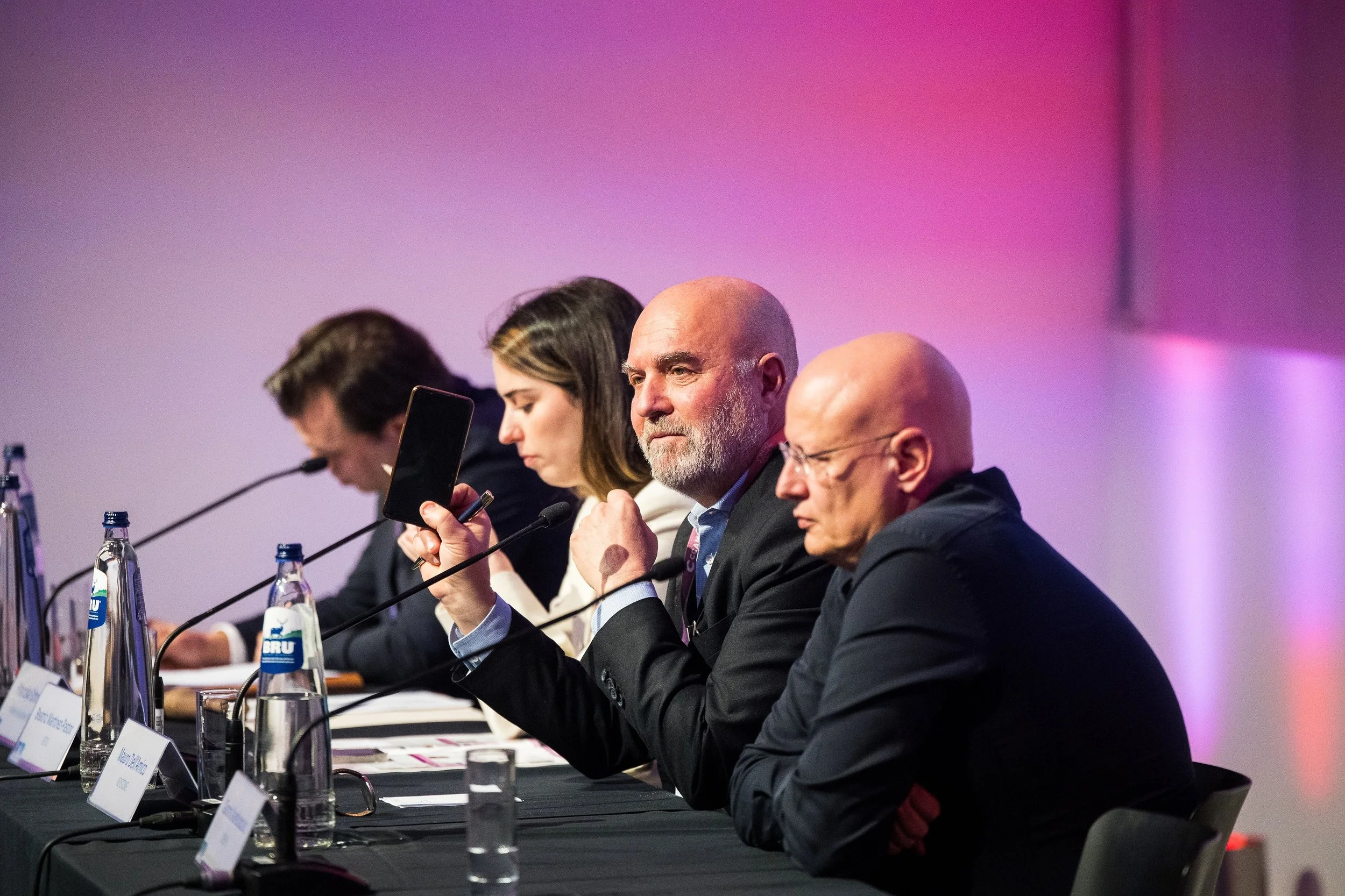
Participants at the Session Smart enforcement for resilient, sustainable and more efficient transport operations in Brussels, Belgium
This year, the RTR Conference returned, offering a unique opportunity for EU-funded initiatives to share their updates and results with a broad audience. From 10 to 12 February 2026, over 1,100 participants attended the conference, both in person and online, representing various areas of road transport from electric motors to inclusiveness, retrofitting, and logistics. The three-day event featured over 95 projects across 32 parallel sessions.
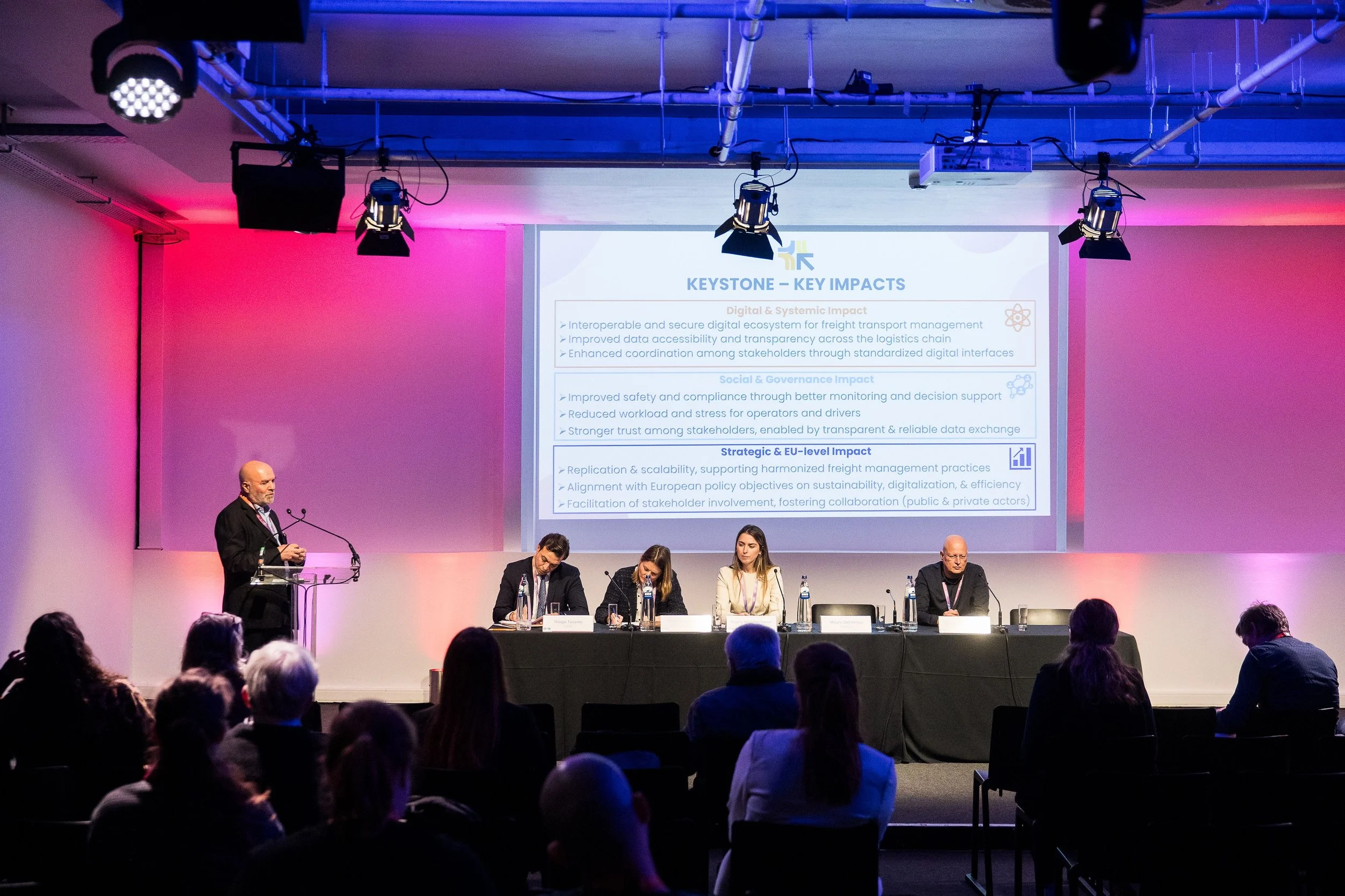
Prof Mauro Dell Amico presenting KEYSTONE project at the RTR 2026 in Brussels, Belgium.
Among them was KEYSTONE, which took centre stage in the session titled “Smart enforcement for resilient, sustainable and more efficient transport operations” on 10 February 2026, from 16:30 to 18:00 CET. KEYSTONE was represented by Professor Mauro Dell’Amico from the University of Modena and Reggio Emilia (UNIMORE), its project coordinator.
Prof Dell’Amico presented the recent results of KEYSTONE, which is concluding in May 2026. To date, the project has developed and validated a digital solution, the KEYSTONE Web App for freight transport in various environments. He first explained the delivery of the API Reference Model, which enables interoperable data exchange between terminal systems, enforcement authorities, transport management systems, and the eCMR platform. Following this, the Web App was developed, facilitating drivers, logistics managers, and enforcement authorities, thanks to its three interfaces. What makes the KEYSTONE Web App unique is its ability to support real-time data exchange, automated compliance checks, and “smart enforcement” mechanisms designed to reduce unnecessary roadside inspections, fuel consumption, and emissions.
As he explained, the Web App has already been tested in real-world cases through two pilot scenarios: a) a road transport scenario, and b) an intermodal transport scenario. These two pilots validated real-time ETA transmission, cargo data accuracy, and digital coordination between logistics operators, port authorities, and enforcement bodies.
Up to now, the findings of the project show improvements in operational efficiency, data reliability, and enforcement compliance procedures, contributing to reduced workload, lower fuel consumption, shorter engine-on time, and improved emissions performance.
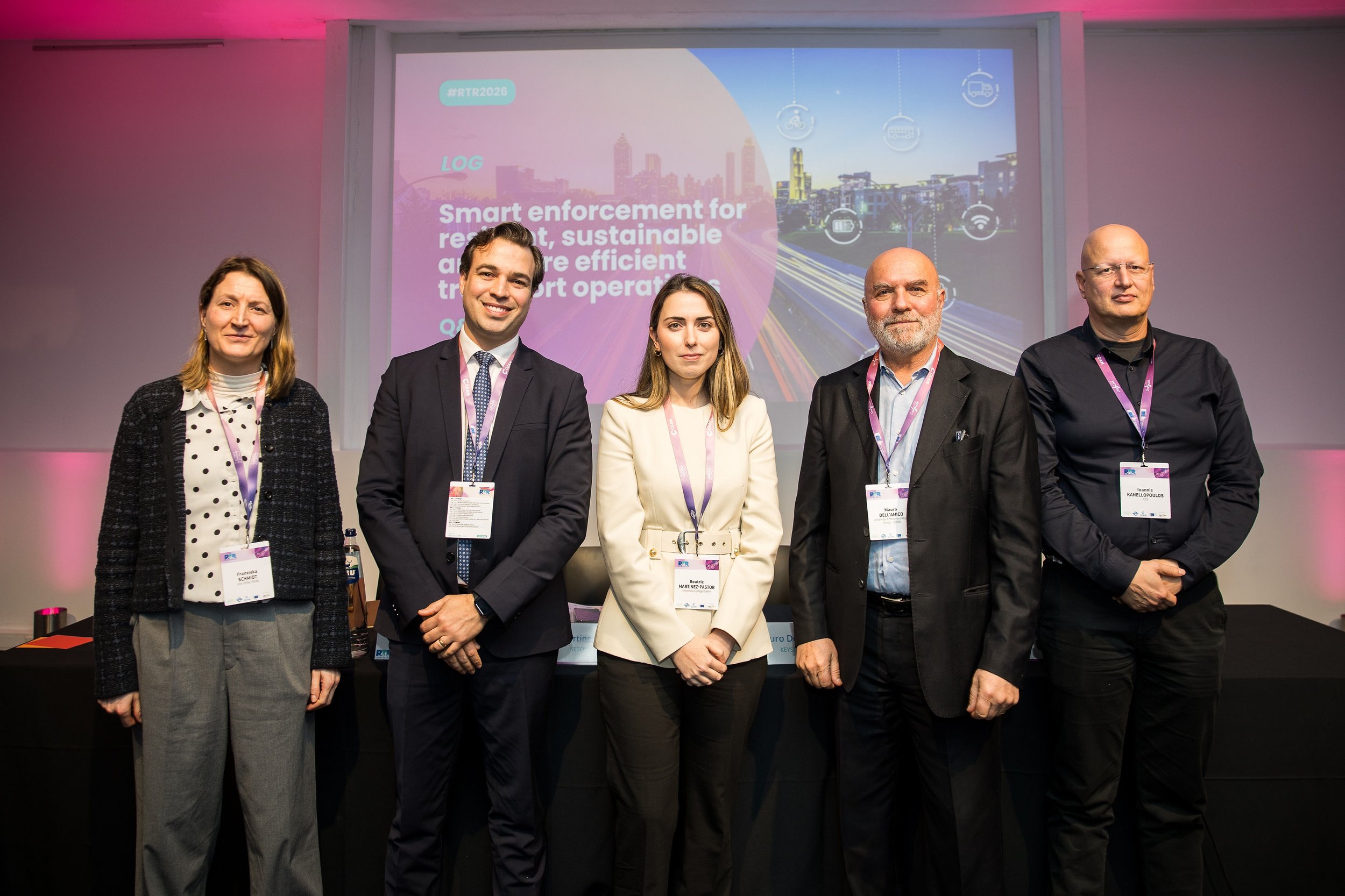
From left to right: Franziska Schmidt (University Gustave Eiffel), Thiago Tavares (CINEA), Dr Beatriz Martinez Pastor (UCD), Prof Mauro Dell’ Amico (UNIMORE), Giannis Kanellopoulos (ICCS)
The session was a great opportunity to showcase how EU initiatives contribute to the European Commission’s Work Programme on smart enforcement and resilient, sustainable and more efficient operations in Europe and beyond. It sparked many questions from the audience on the sustainability and scalability of the projects’ results beyond their conclusion.
The panel was moderated by Thiago Tavares from the European Climate, Infrastructure and Environment Executive Agency (CINEA) of the European Commission and Franziska Schmidt from the Gustave Eiffel University. It featured engaging discussions from fellow EU-funded projects, including:
SETO, the sister project of KEYSTONE, represented by Dr Beatriz Martinez Pastor from University College Dublin (UCD);
DELPHI, represented by Giannis Kanellopoulos from the Institute of Communication andComputer Systems (ICCS)
Key takeaways from the session
This year, the RTR Conference closed with a clear message: 2026 will be a year of change. From KEYSTONE’s side, we are proud to contribute to this transformation by facilitating data exchange in a safer, more efficient, smart, and sustainable way.
Find the full session available in the video below.
Author: Eftychia Koliou, Smart Transportation Alliance (STA)