

Bridging Theory and Practice: How KEYSTONE Advances Plug & Play Interoperability in European Logistics
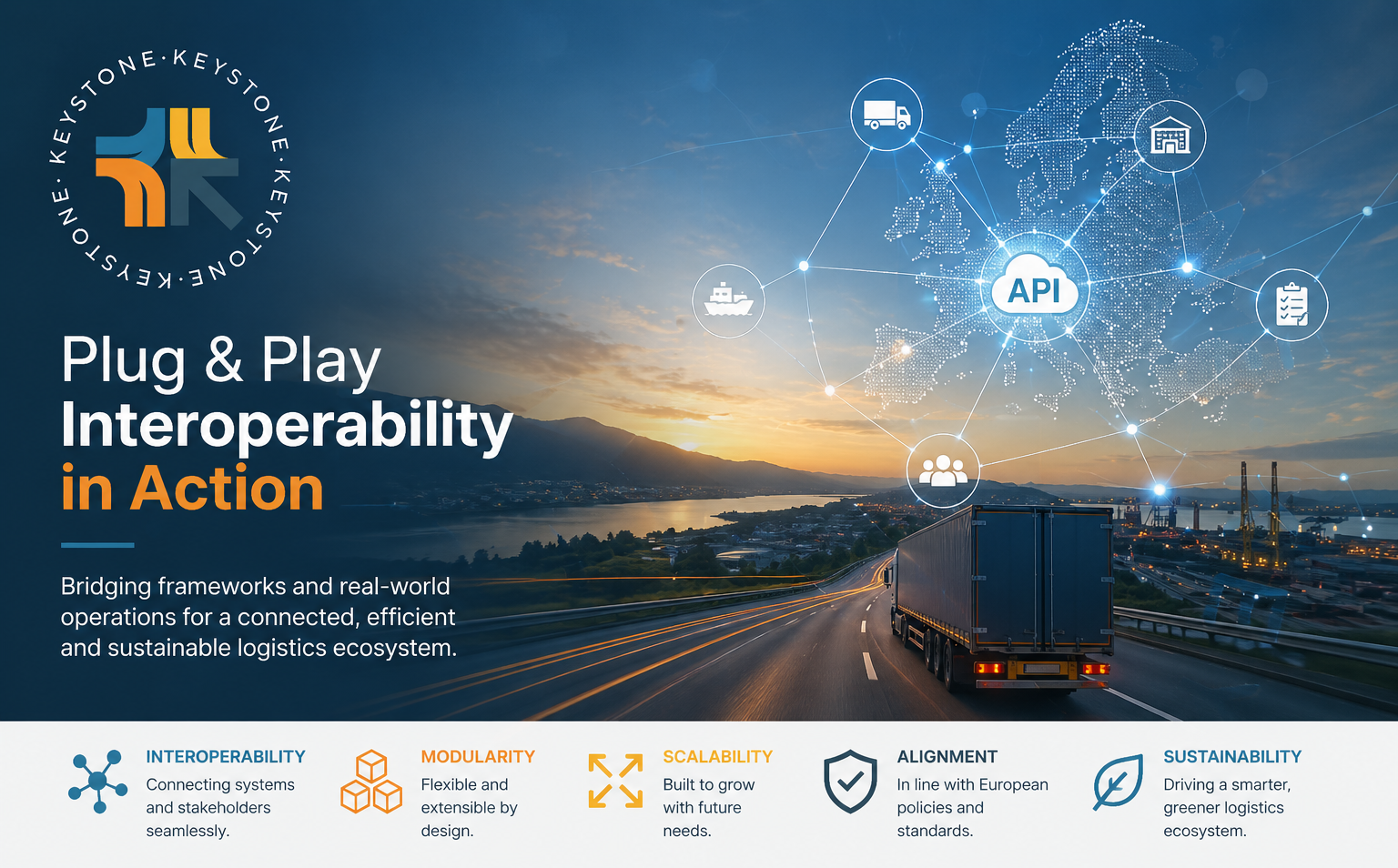
Within the evolving landscape of European digital logistics, one of the most pressing challenges remains the gap between high-level interoperability frameworks and their concrete implementation in real-world operations. The KEYSTONE project addresses this challenge through its work in Task 5.3 Evaluation with DTLF working group related to Plug & Play, led by GRUBER Logistics, focusing on the evaluation of Plug & Play interoperability in alignment with the Digital Transport and Logistics Forum (DTLF).
At its core, the activities of the task were designed to assess the maturity, relevance, and practical applicability of the Plug & Play concept as implemented in KEYSTONE. Building on GRUBER Logistics’ active involvement in the DTLF—both as observers and through direct participation in its activities—the project ensured continuous alignment with European policy discussions, particularly within the framework of DTLF Subgroup 2.
A central objective of the task was to evaluate how KEYSTONE responds to the needs identified by the DTLF, which has consistently highlighted the gap between conceptual interoperability frameworks and their real-world deployment. In this context, KEYSTONE was designed not only to reflect these recommendations but also to contribute practical implementation insights back to the policy discussion.
During the course of the project, a key turning point emerged with the evolution of the DTLF structure, including the discontinuation of the dedicated Plug & Play subgroup under the new mandate. This created a structural challenge for the evaluation process, which had originally been designed around direct interaction with this expert group.
In response, KEYSTONE adapted its approach by engaging directly with leading experts previously involved in DTLF Plug & Play discussions. Through targeted outreach and a qualitative review process, the project successfully ensured continuity with earlier work while adapting to the new institutional context.
The feedback collected from experts such as Philippe Michiels (imec), Wout Hofman (TNO), and Eusebiu Catana (ERTICO – ITS Europe) provided valuable guidance. While recognising the solid technical foundation of the KEYSTONE API Reference Model, reviewers emphasised the need to further evolve towards event-driven architectures, strengthen alignment with emerging frameworks such as eFTI and data spaces, and ensure scalability through modular and extensible design.
These insights directly informed the outcomes of the task, contributing to Deliverable D5.3, which provides a structured evaluation of the KEYSTONE approach in relation to DTLF expectations and European interoperability priorities.
Ultimately, the activities demonstrate that Plug & Play is not only a technical concept, but a broader design philosophy for the future of logistics—one that requires interoperability by design, continuous alignment with policy, and the ability to translate theory into deployable solutions.
By combining expert input, practical validation, and policy engagement, KEYSTONE contributes to bridging the gap between conceptual frameworks and operational reality in European transport and logistics.
Author: Fabrizio Borgogna, Gruber Logistics